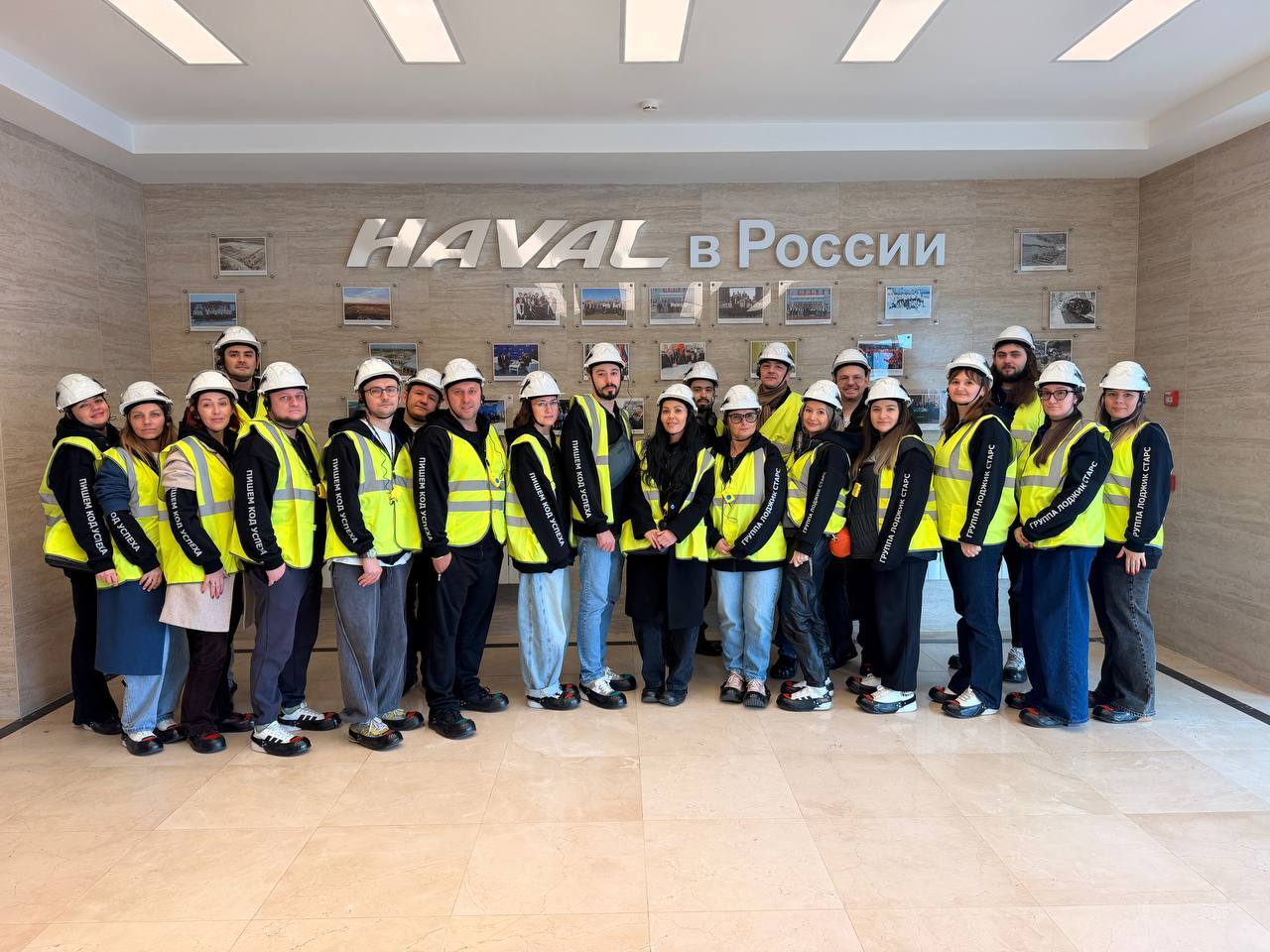
This week, the GLS team visited the Haval plant in the Tula Region to learn about its production operations and the people behind them. The programme included a tour of the workshops. We saw every stage of production, from stamping to assembly, and witnessed the “wedding” — the term the plant uses for the moment the body is joined to the engine and suspension. Here is what impressed us most.
A Plant Built on a Greenfield Site
The plant is part of the Chinese automaker Great Wall Motor. The agreement to build it was signed in 2014, when the site was an empty field. Main construction took approximately three years, and the plant officially opened in June 2019.
Today it is a full-cycle facility: stamping, welding, painting, assembly and an in-house engine plant. The main production area exceeds 190,000 m², with a design capacity of 150,000 vehicles per year. The plant currently employs around 7,000 people, with staff transport provided throughout the Tula Region.
Quality Control
The plant’s motto is “Improving a little every day,” and this is evident in every process. Body parts are stamped on site: the plant receives double-sided galvanised steel. A 2,000-tonne press then takes each part through four dies:
During our visit, several bonnets were stamped for one of the flagship models. Every 30th part is taken off the line and checked on measuring equipment, and twice a year the plant shuts down completely for scheduled preventive maintenance.
On the assembly line, quality is monitored by the Andon system. This is a lean manufacturing tool originating at Toyota; the word itself means “paper lantern” in Japanese. Screens above the line display the target (320 vehicles per shift) and the completion rate in real time, and a red signal immediately indicates that something is going wrong.
Robots and the “Wedding” Itself
Hundreds of robots operate at the plant — assembling, welding, delivering and inspecting — with around 300 robots in the welding shop alone. A notable detail: the dashboard module, weighing around 100 kg, is installed in a matter of seconds. And at one of the key assembly stages, the “wedding” takes place — from that moment on, the car truly becomes a whole.
The Colour of a Hard Hat Says a Lot
The plant has its own hard hat colour code:
What’s in a Name?
Haval derives from the English phrase “Have it all.” Jolion, the best-selling foreign-brand car in Russia in 2025, is called Chulian in China, meaning “first love.” The Dargo is known as DaGou in its home market, meaning “big dog,” while for Russia the name was interpreted as “dare to go.”
We would like to thank the Haval team, who found time in their busy schedule to meet with us. It is always a pleasure to speak with people who, like us, understand the value of precision and well-tuned processes.
A Plant Built on a Greenfield Site
The plant is part of the Chinese automaker Great Wall Motor. The agreement to build it was signed in 2014, when the site was an empty field. Main construction took approximately three years, and the plant officially opened in June 2019.
Today it is a full-cycle facility: stamping, welding, painting, assembly and an in-house engine plant. The main production area exceeds 190,000 m², with a design capacity of 150,000 vehicles per year. The plant currently employs around 7,000 people, with staff transport provided throughout the Tula Region.
Quality Control
The plant’s motto is “Improving a little every day,” and this is evident in every process. Body parts are stamped on site: the plant receives double-sided galvanised steel. A 2,000-tonne press then takes each part through four dies:
- Forming: the flat sheet is given its three-dimensional shape.
- Piercing: holes are punched.
- Trimming: excess metal is cut away from the part.
- Calibration: the part is brought to exact dimensions.
During our visit, several bonnets were stamped for one of the flagship models. Every 30th part is taken off the line and checked on measuring equipment, and twice a year the plant shuts down completely for scheduled preventive maintenance.
On the assembly line, quality is monitored by the Andon system. This is a lean manufacturing tool originating at Toyota; the word itself means “paper lantern” in Japanese. Screens above the line display the target (320 vehicles per shift) and the completion rate in real time, and a red signal immediately indicates that something is going wrong.
Robots and the “Wedding” Itself
Hundreds of robots operate at the plant — assembling, welding, delivering and inspecting — with around 300 robots in the welding shop alone. A notable detail: the dashboard module, weighing around 100 kg, is installed in a matter of seconds. And at one of the key assembly stages, the “wedding” takes place — from that moment on, the car truly becomes a whole.
The Colour of a Hard Hat Says a Lot
The plant has its own hard hat colour code:
- Orange — visitors
- Yellow — stamping and welding staff
- Blue — maintenance service
- White — engineers and specialists
- Red — management only
What’s in a Name?
Haval derives from the English phrase “Have it all.” Jolion, the best-selling foreign-brand car in Russia in 2025, is called Chulian in China, meaning “first love.” The Dargo is known as DaGou in its home market, meaning “big dog,” while for Russia the name was interpreted as “dare to go.”
We would like to thank the Haval team, who found time in their busy schedule to meet with us. It is always a pleasure to speak with people who, like us, understand the value of precision and well-tuned processes.