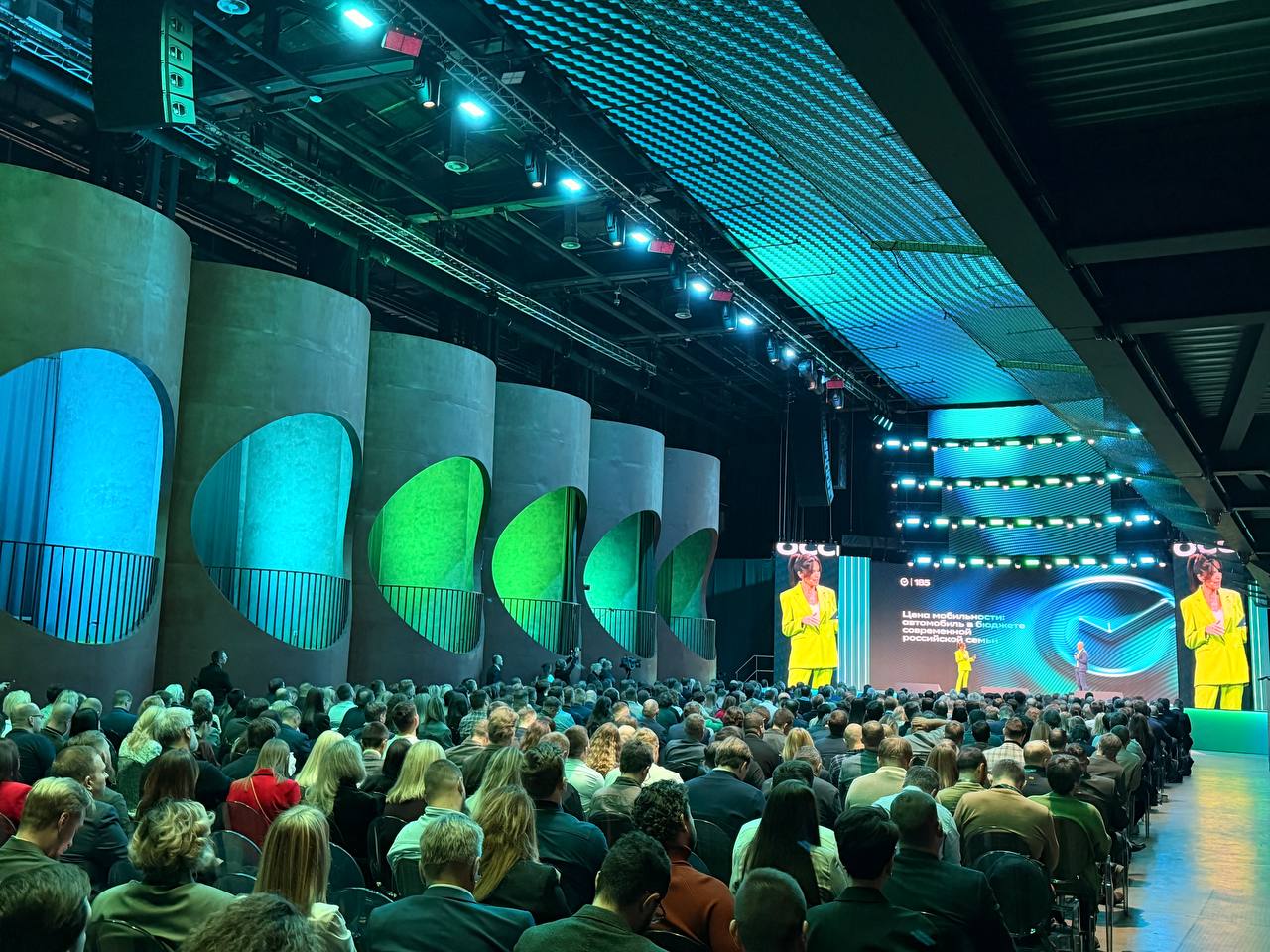
On 22 October 2026, Sber hosted the Strategic Automotive Industry Forum “For Those in the Driver’s Seat” at the TAU venue in Moscow. The forum brought together representatives of the relevant government authorities, senior executives from banks, technology companies and digital platforms, as well as owners and executives of automakers and dealer holdings.
The programme featured presentations and discussions on how motorists’ needs are changing and what this means for production, sales, financing and service. Below are the key points from four sessions: the plenary discussion among market leaders, the session on the automotive industry development strategy to 2035, the address by Natalia Rusova, Director of Sberbank’s Auto Division, and the presentation on Chinese automotive industry practices.
Plenary Session: How the Customer Is Changing
The plenary session of automotive market leaders featured Kirill Tsarev (First Deputy Chairman of the Executive Board, Sberbank), Kirill Grigoriev (Deputy Chairman of the Management Board, T-Bank), Sergei Piven (Managing Partner, Avito), Anna Kurochkina (Marketing Director, AVTOVAZ JSC) and Andrei Olkhovsky (CEO, Avtodom). The topic was how products and the roles of market participants are changing, and what drives customer loyalty.
Key discussion points:
Automotive Industry Strategy to 2035: What Matters for Business
The automotive industry development strategy to 2035 was presented by Grigory Tsyba, Director of the Department of Automotive Industry and Railway Engineering at the Ministry of Industry and Trade of the Russian Federation, and Andrei Enin, Director of the Department of State Policy for Automotive and Urban Passenger Transport at the Ministry of Transport of the Russian Federation.
Ministry of Industry and Trade: From Recovery to Localisation
According to Grigory Tsyba, after 2022 the state’s primary objective was to preserve enterprises and expertise. The exit of foreign partners set the industry back by roughly 10 years: production sites, equipment and model ranges had to be relaunched from scratch. Over three years, this objective has been achieved: virtually all sites have been restarted, and new models are in production in every segment where there is demand. In theory, enterprises are capable of producing around 3 million vehicles per year. The next stage is deeper localisation, higher capacity utilisation, larger production runs and lower production costs.
Key principles of the new strategy:
State support will cover the full cycle — from development to sale to the end customer — and will be tied to localisation. Localisation requirements will be raised annually. Each plant operates under a special investment contract, and a points-based system by component is used to assess localisation.
The Industrial Development Fund is currently focusing on complex assemblies: engine production has already been launched in the Tula Region, and a full-cycle automatic transmission production facility is being prepared, with the first phase scheduled for September. Transmission projects are also being supported in Tatarstan. The budget for the upcoming three-year period is still being finalised, but demand stimulus measures will remain in place until 2035. Discounts on natural gas vehicles are set to increase next year. By 2035, production capacity should be almost fully utilised, and the share of Russian-made products in sales should reach 80%. At the pre-2022 sales peak, it stood at around 85%.
Ministry of Transport: Fleet Renewal and New Services
Andrei Enin explained that, for the Ministry of Transport, a vehicle is a tool for carrying passengers and freight and ensuring territorial connectivity. Products must therefore be reliable, safe and comfortable. The Transport Strategy has been updated to 2036 with an outlook to 2050 and is currently undergoing approval.
Both speakers urged businesses to engage in direct dialogue. Platforms for this include the Public Transport Forum, the public council, Transport Week and videoconference meetings.
Natalia Rusova: Transaction-Ready Customers Are Now the Scarce Resource
Natalia Rusova, Director of Sberbank’s Auto Division, described how data, services and collaboration with partners help identify the moment a person is ready to buy a car and make the transaction safer. She noted that the forum programme deliberately went beyond traditional automotive events: in addition to market leaders and government representatives, experts in design, marketing and technology also took the stage.
The Market’s Main Challenge
Buyers’ questions have evolved in recent years. First, it was where to buy a car at all — a question that was last relevant quite recently, in 2023. Then it was where to find a good car and how to finance it. Today, product is available and choice is vast; the scarce resource is now a customer who is ready to transact. According to Natalia Rusova, one of Sber’s most important assets is not only its data but also its ability to work with it. The bank is ready to share this expertise with partners, including on the basis of jointly enriched data.
Identifying the Moment of Purchase
Based on these triggers, Sber builds recommendation systems in order to be present when the customer is making a choice. In a world of intense information pressure, the speaker emphasised, it is important to find the right moment for communication — and that is what personalisation means.
Digital Secure Transaction
Buying a car is one of the most stressful events in a person’s life: on average, a family buys 5–7 cars over a lifetime. In the dealer channel, the process follows automakers’ standards, whereas private buyer-to-seller transactions carry greater risks. Sber’s strategy therefore places particular emphasis on solutions for this segment.
Several months ago, the bank launched a digital secure transaction service on the market. Buyer and seller can see every step, funds are transferred in a protected mode, and documents are signed within the transaction. This makes it possible to offer a secured car loan that is cheaper than a consumer loan. As a result, a person can buy a more expensive car or the desired trim level — or afford a purchase at all. All these solutions, Natalia Rusova noted, are developed by Sber together with market partners, technology companies and the state.
Insights from the Chinese Automotive Industry for the Russian Market
The presentation by Zhang Liqun, Director of the Chinese Business Centre at B1 Group, examined how the Chinese automotive industry has reshaped the market structure and which of its practices are applicable in Russia. The centre works with approximately 100 Chinese companies in Russia, including Huawei, Xiaomi and ZTE.
The Buyer Defines the Market
The Chinese consumer is among the most demanding in the world. For them, a car has become an everyday necessity, and for the younger generation, a “second living room” between home and office. German brands are no longer perceived as status symbols, and the share of German, Japanese and American cars in China is shrinking year by year. Buyers expect seamless connectivity with their smartphone and smart home, a multimedia system that works like a tablet, and regular software updates for several years after purchase. Manufacturers receive customer feedback directly, without a long chain of dealers and service companies, and respond faster.
Three Competitive Factors
What Drives Low Prices
According to Zhang Liqun, the low price of Chinese cars is not a result of cheap labour. It is driven by market scale — around 26 million vehicles per year — industrial clusters in which all suppliers are located close together, and automation, which reaches 98–100% at plants, up to fully robotised “dark factories.” Intense domestic competition pushes the best products out to foreign markets — Russia, Southeast Asia, the Middle East and Europe.
What Is Applicable in Russia
Zhang Liqun concluded his presentation with a question to the audience: the consumer has already changed — is business ready to change too? The forum showed that market participants — the state, manufacturers, dealers, banks and technology companies — are seeking the answer together.
The programme featured presentations and discussions on how motorists’ needs are changing and what this means for production, sales, financing and service. Below are the key points from four sessions: the plenary discussion among market leaders, the session on the automotive industry development strategy to 2035, the address by Natalia Rusova, Director of Sberbank’s Auto Division, and the presentation on Chinese automotive industry practices.
Plenary Session: How the Customer Is Changing
The plenary session of automotive market leaders featured Kirill Tsarev (First Deputy Chairman of the Executive Board, Sberbank), Kirill Grigoriev (Deputy Chairman of the Management Board, T-Bank), Sergei Piven (Managing Partner, Avito), Anna Kurochkina (Marketing Director, AVTOVAZ JSC) and Andrei Olkhovsky (CEO, Avtodom). The topic was how products and the roles of market participants are changing, and what drives customer loyalty.
Key discussion points:
- Electrified segment. In September, the share of electric and hybrid vehicles reached a record high. Growth is not rapid, but participants regard it as a sustainable trend.
- Customer journey. In the past, a buyer would visit a website and their intentions would be immediately clear. Today, the decision is shaped by numerous micro-touchpoints — the website, blogger reviews and other sources — and only then comes contact with a salesperson. At the same time, the online channel is becoming more important: people want quick answers.
- The app as a channel. A mobile app is no longer merely a service but a channel through which the company gains customer insight and the customer can control the vehicle. This makes it possible to make the offers the customer is expecting.
- AI agents. Participants identified the emergence of customer agents as the next step — a new type of entity the market will need to learn to work with.
- Trust. The audience was asked whether trust in the industry has grown over the past 10 years. Most participants refrained from answering.
Automotive Industry Strategy to 2035: What Matters for Business
The automotive industry development strategy to 2035 was presented by Grigory Tsyba, Director of the Department of Automotive Industry and Railway Engineering at the Ministry of Industry and Trade of the Russian Federation, and Andrei Enin, Director of the Department of State Policy for Automotive and Urban Passenger Transport at the Ministry of Transport of the Russian Federation.
Ministry of Industry and Trade: From Recovery to Localisation
According to Grigory Tsyba, after 2022 the state’s primary objective was to preserve enterprises and expertise. The exit of foreign partners set the industry back by roughly 10 years: production sites, equipment and model ranges had to be relaunched from scratch. Over three years, this objective has been achieved: virtually all sites have been restarted, and new models are in production in every segment where there is demand. In theory, enterprises are capable of producing around 3 million vehicles per year. The next stage is deeper localisation, higher capacity utilisation, larger production runs and lower production costs.
Key principles of the new strategy:
- Technological control. Russian owners must hold at least 51% in joint ventures, and design documentation must remain with them. This is intended to prevent a repeat of 2022, when foreign owners exited and took the documentation with them.
- Component standardisation. Different brands and models should share common components wherever possible — across platforms and sites — to achieve production scale.
- In-house engineering centres to independently refine localised models.
- Balanced powertrain mix. Internal combustion engines, including natural gas vehicles, will remain the backbone. Electric transport is being developed in parallel: its sales have doubled. By 2030, electric and hybrid vehicles are expected to account for 25% of the market.
- Technology. Enterprises are being steered towards driver assistance systems and the digital connected car.
- Labour productivity is expected to grow by approximately 10% per year.
State support will cover the full cycle — from development to sale to the end customer — and will be tied to localisation. Localisation requirements will be raised annually. Each plant operates under a special investment contract, and a points-based system by component is used to assess localisation.
The Industrial Development Fund is currently focusing on complex assemblies: engine production has already been launched in the Tula Region, and a full-cycle automatic transmission production facility is being prepared, with the first phase scheduled for September. Transmission projects are also being supported in Tatarstan. The budget for the upcoming three-year period is still being finalised, but demand stimulus measures will remain in place until 2035. Discounts on natural gas vehicles are set to increase next year. By 2035, production capacity should be almost fully utilised, and the share of Russian-made products in sales should reach 80%. At the pre-2022 sales peak, it stood at around 85%.
Ministry of Transport: Fleet Renewal and New Services
Andrei Enin explained that, for the Ministry of Transport, a vehicle is a tool for carrying passengers and freight and ensuring territorial connectivity. Products must therefore be reliable, safe and comfortable. The Transport Strategy has been updated to 2036 with an outlook to 2050 and is currently undergoing approval.
- Bus fleet renewal. More than 27,000 buses were renewed in 2022–2025, and a further 27,000 are needed by 2030. The target set by the President: by 2030, at least 85% of public transport must be within its standard service life (up to 10 years). Many regions have already exceeded this figure.
- Financing. Fleet renewal is supported by subsidies, leasing through the State Transport Leasing Company (GTLK) and, from this year, direct subsidies to the regions.
- Infrastructure. Passengers value not only a new bus but also stops with arrival-time information.
- Demand-responsive transport. A service in which passengers book trips in advance and the bus builds its route around the requests will be piloted in 7 regions.
- Electric transport. Moscow’s electric buses have switched to fast charging. An electric KAMAZ truck is being tested; the limitation for the freight segment is battery weight.
- Autonomous trucks. A pilot with Kazakhstan has been completed — the first step towards international autonomous freight transport. Further development of this area requires a law on highly automated vehicles.
Both speakers urged businesses to engage in direct dialogue. Platforms for this include the Public Transport Forum, the public council, Transport Week and videoconference meetings.
Natalia Rusova: Transaction-Ready Customers Are Now the Scarce Resource
Natalia Rusova, Director of Sberbank’s Auto Division, described how data, services and collaboration with partners help identify the moment a person is ready to buy a car and make the transaction safer. She noted that the forum programme deliberately went beyond traditional automotive events: in addition to market leaders and government representatives, experts in design, marketing and technology also took the stage.
The Market’s Main Challenge
Buyers’ questions have evolved in recent years. First, it was where to buy a car at all — a question that was last relevant quite recently, in 2023. Then it was where to find a good car and how to finance it. Today, product is available and choice is vast; the scarce resource is now a customer who is ready to transact. According to Natalia Rusova, one of Sber’s most important assets is not only its data but also its ability to work with it. The bank is ready to share this expertise with partners, including on the basis of jointly enriched data.
Identifying the Moment of Purchase
- Auto section in SberBank Online. It already contains 15 million vehicles, and customers regularly visit and use its services.
- Savings. 25 million customers save with Sber. The most popular scenario for buying the next car is personal savings combined with a loan. Saving for a car ranks among customers’ top goals, and many specify the goal down to a particular model.
- Car loan maturity. A proven trigger: when a person’s loan on their current car is nearing its end, they are ready to consider a new loan and a vehicle change.
- Vehicle valuation. Customers like the car valuation service. The more often a person checks the value of their car, the more likely they are to replace it.
- Life events. The birth of a child in a young family with a two-seat sports car, or a move away from a city with well-developed public transport, are reasons to talk about a new purchase.
Based on these triggers, Sber builds recommendation systems in order to be present when the customer is making a choice. In a world of intense information pressure, the speaker emphasised, it is important to find the right moment for communication — and that is what personalisation means.
Digital Secure Transaction
Buying a car is one of the most stressful events in a person’s life: on average, a family buys 5–7 cars over a lifetime. In the dealer channel, the process follows automakers’ standards, whereas private buyer-to-seller transactions carry greater risks. Sber’s strategy therefore places particular emphasis on solutions for this segment.
Several months ago, the bank launched a digital secure transaction service on the market. Buyer and seller can see every step, funds are transferred in a protected mode, and documents are signed within the transaction. This makes it possible to offer a secured car loan that is cheaper than a consumer loan. As a result, a person can buy a more expensive car or the desired trim level — or afford a purchase at all. All these solutions, Natalia Rusova noted, are developed by Sber together with market partners, technology companies and the state.
Insights from the Chinese Automotive Industry for the Russian Market
The presentation by Zhang Liqun, Director of the Chinese Business Centre at B1 Group, examined how the Chinese automotive industry has reshaped the market structure and which of its practices are applicable in Russia. The centre works with approximately 100 Chinese companies in Russia, including Huawei, Xiaomi and ZTE.
The Buyer Defines the Market
The Chinese consumer is among the most demanding in the world. For them, a car has become an everyday necessity, and for the younger generation, a “second living room” between home and office. German brands are no longer perceived as status symbols, and the share of German, Japanese and American cars in China is shrinking year by year. Buyers expect seamless connectivity with their smartphone and smart home, a multimedia system that works like a tablet, and regular software updates for several years after purchase. Manufacturers receive customer feedback directly, without a long chain of dealers and service companies, and respond faster.
Three Competitive Factors
- Speed. European manufacturers bring a new model to market in 48–60 months; Chinese manufacturers do so in 18–24 months.
- Vertical integration. Batteries, electric motors, inverters, electronics and chips are produced domestically and controlled by Chinese capital — as at BYD, for example. According to the speaker, the cost of batteries and electric motors is lower than that of European competitors.
- A new revenue model. Hardware is sold at minimal margin. The bulk of profit comes from software updates, subscriptions, service and the brand ecosystem. The purchase of a car is not the end but the beginning of the customer relationship.
What Drives Low Prices
According to Zhang Liqun, the low price of Chinese cars is not a result of cheap labour. It is driven by market scale — around 26 million vehicles per year — industrial clusters in which all suppliers are located close together, and automation, which reaches 98–100% at plants, up to fully robotised “dark factories.” Intense domestic competition pushes the best products out to foreign markets — Russia, Southeast Asia, the Middle East and Europe.
What Is Applicable in Russia
- Do not copy directly. Chinese cars are designed for the Chinese consumer. The Russian market differs in its wide temperature ranges, harsh winters and different charging infrastructure.
- Localisation and joint development of batteries, electronics and software. There is no need to build everything from scratch — technology transfer can be negotiated with Chinese manufacturers.
- Refresh the model range more often. Russian manufacturers need not move to an 18–24-month cycle, but selling one model for 10 years is no longer viable. In the speaker’s view, the benchmark is around three years.
- Digitalisation. Those who switch to a new energy vehicle with digital services rarely go back. The speaker expects demand in Russia to shift in this direction as well.
Zhang Liqun concluded his presentation with a question to the audience: the consumer has already changed — is business ready to change too? The forum showed that market participants — the state, manufacturers, dealers, banks and technology companies — are seeking the answer together.