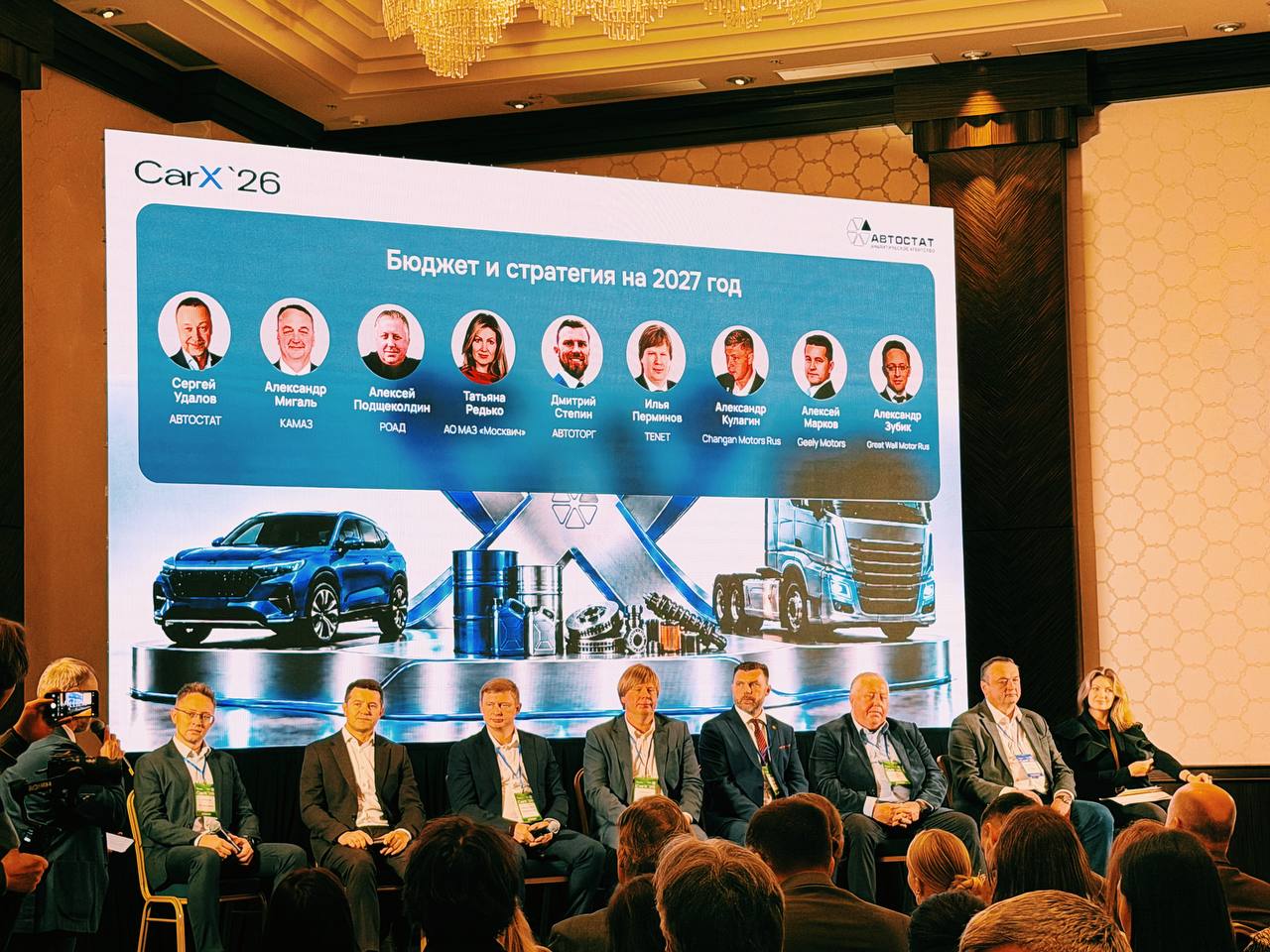
On 6 October, Autostat hosted the CarX 2026 automotive business forum in Moscow. More than 500 industry professionals gathered in a single venue: distributors and dealers, service operations managers, lubricant manufacturers and sellers, and providers of financial and digital services. It was one of those occasions when the entire value chain, from the factory to the service centre, discusses shared challenges together.
The agenda reflected the issues currently front of mind for every market participant: the 2027 forecast, localisation and the recycling fee, customer expectations and the future of the market. The headline topic of the day was the dialogue between dealers and distributors on brands and branding: how to allocate roles, responsibilities and budgets so that both sides can turn a profit.
Below are the key takeaways from the forum: figures, forecasts and quotes.
The Market: “Restrained and Conservative”
Approximately 1 million vehicles were sold in Russia between January and September. Market panel participants expect 2026 to close at 1.40–1.42 million units. The forecast for 2027 is 1.4–1.5 million units, implying growth of no more than 4%. The market has been trailing last year’s figures for three consecutive months, and no one is anticipating a boom.
The most illustrative formula for the market was put as follows: divide consumers’ available funds by the price of a car. In hard-currency terms, people have roughly the same amount of money as they did 15 years ago. At that time, the average car cost RUB 900,000 and the market stood at 3 million units; today the average car costs RUB 3.5 million and the market is around 1.4 million units.
Key trends identified:
Manufacturers and distributors heard the same request several times: do not overload dealers with stock for 2027. Shipping more vehicles than a city can absorb triggers a price war at the end of every month. “Let dealers make a profit.”
Service and Lubricants: Customers Are Not Lost on Price
Customer surveys show that price has almost no impact on how service is rated. Other factors are decisive: how quickly an appointment can be booked, how long the vehicle reception takes and the quality of the work, with impressions forming even before the car enters the service bay. Retaining customers after the warranty expires is one of a dealer’s key objectives.
On lubricants: less than 9% of engine oil is purchased from authorised dealers, while marketplaces and online stores together account for around 18%. One in five buyers never even reaches a dealer. Around 42% of people find advertising irritating. Non-skippable video ads cause the most annoyance, while outdoor advertising and bloggers cause the least. The researchers’ conclusion: create useful content and communicate with customers directly, without advertising — and dealers already have everything they need to do so.
Dealer and Distributor: Who Creates Demand
The central discussion of the day focused on how to allocate roles and budgets so that both sides can turn a profit.
How it should work. Anna Dudkina (Avtodom / Avtospetscentr Group) described the model as follows: the distributor creates demand, meaning it is responsible for awareness, share of voice and national channels. The dealer converts that demand into transactions through test drives, lead management and local offers. The model only works as a partnership: the dealer picks up the national campaign and adapts it to its city. Data exchange must also flow both ways. The distributor shares demand by region, while the dealer reports back on what local customers actually want.
What has changed. Since 2022, some distributors have shifted responsibility for demand generation onto dealers. Co-funding is hard to obtain, and approval of adapted advertising can take up to a week. Around 60% of a brand’s sales may now pass through its dealer network, with the remainder captured by parallel imports and online channels. In response, major dealers have begun investing in their own brands. Car brands come and go, but customers stay with the dealer for service, parts and trade-ins.
What will help. Participants agreed that the market’s main deficit is trust. Dozens of new brands have entered over the past three years, and buyers choose mainly on price. A brand is not built in a single season: as was noted from the stage, Audi took around 30 years to establish itself in the premium segment. As one speaker put it, “If a distributor has no brand budget, no amount of dialogue will create one.” Distributors therefore need budgets for brand development, dealers need greater freedom in local marketing, and both sides need a realistic sales plan and shared data.
Bottom line: the market will barely grow in 2027 — the winners will be those who generate revenue through trust and service.
The Market: “Restrained and Conservative”
Approximately 1 million vehicles were sold in Russia between January and September. Market panel participants expect 2026 to close at 1.40–1.42 million units. The forecast for 2027 is 1.4–1.5 million units, implying growth of no more than 4%. The market has been trailing last year’s figures for three consecutive months, and no one is anticipating a boom.
The most illustrative formula for the market was put as follows: divide consumers’ available funds by the price of a car. In hard-currency terms, people have roughly the same amount of money as they did 15 years ago. At that time, the average car cost RUB 900,000 and the market stood at 3 million units; today the average car costs RUB 3.5 million and the market is around 1.4 million units.
Key trends identified:
- Localisation. Locally manufactured and assembled vehicles account for around 60% of the market, and the share of imports could fall to approximately 30% in 2027.
- Parallel imports have changed their profile. Previously, importers focused on premium vehicles and EVs; now they bring in mass-market Toyota and Mazda models.
- Lending. The key rate is not the only factor: banks approve few applications. The market can only grow through first-time buyers, yet they are precisely the group most often declined.
- Recycling fee. Obtaining compensation for local assembly is very difficult, so local assembly will restrain prices less than expected.
- Fuel. A new risk has emerged: petrol supply disruptions.
Manufacturers and distributors heard the same request several times: do not overload dealers with stock for 2027. Shipping more vehicles than a city can absorb triggers a price war at the end of every month. “Let dealers make a profit.”
Service and Lubricants: Customers Are Not Lost on Price
Customer surveys show that price has almost no impact on how service is rated. Other factors are decisive: how quickly an appointment can be booked, how long the vehicle reception takes and the quality of the work, with impressions forming even before the car enters the service bay. Retaining customers after the warranty expires is one of a dealer’s key objectives.
On lubricants: less than 9% of engine oil is purchased from authorised dealers, while marketplaces and online stores together account for around 18%. One in five buyers never even reaches a dealer. Around 42% of people find advertising irritating. Non-skippable video ads cause the most annoyance, while outdoor advertising and bloggers cause the least. The researchers’ conclusion: create useful content and communicate with customers directly, without advertising — and dealers already have everything they need to do so.
Dealer and Distributor: Who Creates Demand
The central discussion of the day focused on how to allocate roles and budgets so that both sides can turn a profit.
How it should work. Anna Dudkina (Avtodom / Avtospetscentr Group) described the model as follows: the distributor creates demand, meaning it is responsible for awareness, share of voice and national channels. The dealer converts that demand into transactions through test drives, lead management and local offers. The model only works as a partnership: the dealer picks up the national campaign and adapts it to its city. Data exchange must also flow both ways. The distributor shares demand by region, while the dealer reports back on what local customers actually want.
What has changed. Since 2022, some distributors have shifted responsibility for demand generation onto dealers. Co-funding is hard to obtain, and approval of adapted advertising can take up to a week. Around 60% of a brand’s sales may now pass through its dealer network, with the remainder captured by parallel imports and online channels. In response, major dealers have begun investing in their own brands. Car brands come and go, but customers stay with the dealer for service, parts and trade-ins.
What will help. Participants agreed that the market’s main deficit is trust. Dozens of new brands have entered over the past three years, and buyers choose mainly on price. A brand is not built in a single season: as was noted from the stage, Audi took around 30 years to establish itself in the premium segment. As one speaker put it, “If a distributor has no brand budget, no amount of dialogue will create one.” Distributors therefore need budgets for brand development, dealers need greater freedom in local marketing, and both sides need a realistic sales plan and shared data.
Bottom line: the market will barely grow in 2027 — the winners will be those who generate revenue through trust and service.